Showing posts with label Census. Show all posts

Monday, 6 August 2012

Mappy Monday - working at Somerset House


In the census you occasionally come across a description page for an enumeration district like the one above in 1851, which includes a sketch map of the district as well as a list of the streets it contains. I found this one while I was working on one of my pet projects, the story of the people who worked for the General Register Office at Somerset House. 

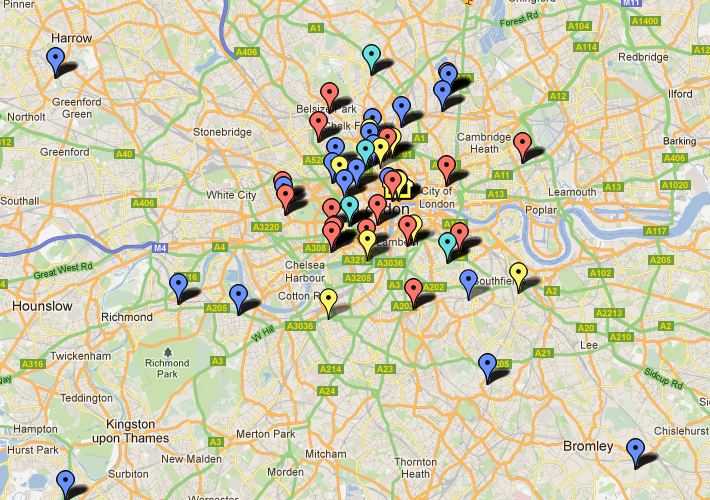
I have been able to find some of these men in the census, and where I could identify them on a modern map of London I have plotted them using Google Maps. I created a map which I have called General Register Office staff. Each marker represents a member of staff in a particular census year, and its tab shows the man's name, the census year, his address and his post in the GRO at that time.
The markers are also colour-coded 1851  red, 1861 - blue, 1871 - pale blue, 1881 - yellow. It's an ongoing project, so not all census years are included yet, and I also need to do more work to locate some addresses where the street names have changed, or where the streets have disappeared altogether. 

I found the census map particularly interesting because the one of the streets shown, Chapel Street, was the home of the Registrar General at the time, George Graham.  

Print

Friday, 4 May 2012

Those Places Thursday - an early census of Macclesfield

Cheshire is a good county to research from a distance, because there are already so many good online resources for the county. These include tithe maps and apportionments are on the Cheshire Archives and Local Studies  site; you can search and download a number of records from FindMyPast including parish registers and wills; additionally, there are indexes to Land Tax Assessments and school records at FamilySearch.

Now a new free site 1611MacclesfieldSurvey.info provides details of a rare early 'census' in the form of a survey of freeholders and tenants in the Forest and Manor of Macclesfield around 1611. There are 700 names, indexed, and also an address index of 64 house names. There is also a bonus in the form of an Index of Extracts from Escheators Books containing 37 names from much earlier periods, the earliest dating from 1362/63. This will be of interest to local historians, and to family historians who have been lucky enough to trace their ancestors this far back in the Macclesfield area.

These names come from the records of the Office of the Auditors of Land Revenue (Ref LR 2/200) in The National Archives.


 Print

Friday, 6 April 2012

Some thoughts on the 1940 census


The release of a new census is always an exciting event. Even if it another country's census you can still join in the excitement. Like many other Brits I have 'cousins' in the USA, so I had a personal interest in the 1940 census, as well as my general interest in all things genealogical.

There are some interesting comparisons to be made between US and British census records, but the first thing that struck me was that the (near) instant availability of images with no indexes was rather a good thing. There have been so many advances in recent decades in the way that records are made available to us that it can make your head spin; so much basic genealogical source material is not only online but name-indexed that we can easily take it for granted.

When I started doing family history research the way to find someone in the census was to establish the address where you hoped they would be on census night, and search there. If you didn't find them there, you trawled the surrounding area until you found them (or not). There were place indexes but not many name indexes. Do I want to go back to those days? Of course not. But there was one big advantage of doing it the hard way; you had no choice but to look at the town or village where your ancestors lived. You might notice in passing some other family members that you wouldn't have gone looking for, and you get a sense of the ancestors' immediate surroundings. In short, you see your family in context. Looking for people in 1940 is a little bit like that, where you can find someone if you know where they were living then and are prepared to take the trouble .

Millions of people certainly tried, and I could tell from messages on Twitter and in blogs that at least some of them succeeded. It wasn't really surprising that not everyone could get through or view images in the first few hours. This always happens when there is a really big online release. The demand is always huge in the first hours or days, well in excess of the number of the hits  the site will get on a daily basis after that. It strikes me that if a site was equipped to accommodate everyone who tried to use it on day one, it would be massively over-resourced as soon as the initial rush subsided; rather like cities that have hosted the Olympics and then find themselves with an oversized airport and too many hotels. Frustrating as it may have been, the fact that some people were able to find and download pages, rather than sites crashing altogether has to be encouraging.

Like many other people I had to give it a try on 2 April, and like many of them I couldn't get through to the image I wanted. I had another go early next morning (GMT) while most of America was asleep, and it worked like a charm! I found great-great-great-uncle Robert in the small town in Minnesota where I knew he'd be. When America woke up again things seemed to have calmed down, and since then people have been finding people at a furious pace. All the images are online, on one site or another, and the first indexes have appeared. Pretty impressive for a country the size of the USA, and in less than a week.

We can get awfully impatient, we 21st century people, but as genealogists who deal in decades and centuries we should be capable of taking a more long-term view, we really should. Amy Coffin (whose We Tree blog is always worth reading) hit the nail on the head when she said on Twitter 'Ok people, you're allowed 3 complaint tweets about the #1940census, then you have to take a chill pill. Pretty generous if you ask me.' (Also well worth following on Twitter @ACoffin).

Having found my own relative in the 1940 census, and a few others I am interested in, I started making my contribution to the common good by logging on to FamilySearch Indexing and transcribing some pages. This is a novel feature of this census, that it is the subject of a massive collaborative project between NARA, Archives.com, FamilySearch and Findmypast.com. This is feasible with American records because the images are freely available for anyone to use, unlike in the UK where the images are Crown Copyright. So you can also find the 1940 census images on other sites, Ancestry.com and MyHeritage.com (who produced the first online index, for Bristol County, Rhode Island). The race is on, and it's fascinating to watch.    

 Print

Saturday, 14 January 2012

Abundant Genealogy - Week 2 - Paid Online Genealogy Tools


Paid online genealogy tools are essential to the researcher today, but the choice can be bewildering, especially for the beginner. I am sometimes asked 'Which is the best?', but there is no simple answer. First of all you need to ask yourself what records you need to look at, and then find the site or sites that have them. Some popular records, like the census. are on multiple sites, so you have a choice, but many others can only be found on a single site, so if that's what you need to look at, then that's where you need to go. Decision made. The other choice you may have to make is how to pay for the records you want to access; you don't always have a choice, but sometimes you can select different subscription levels or time periods, or even a pay-per-view option.

I am most familiar with British records, so these are the examples I am going to discuss here, starting with the census for England and Wales. Indexed census images are on a number of sites, such as Ancestry.co.uk, Findmypast.co.uk, Genes Reunited , TheGenealogist.co.uk or British Origins and they all have their strengths and weaknesses. Apart from 1881, where everyone uses the same set of transcription data, you will find some differences in the transcriptions. Even where the data is the same, the search engine on one site may work better for you than another. So whatever site you use, it is often worth checking one of the others if your search is unsuccessful.

For most other records you will have fewer sites to choose from, because there is much less duplication. So you need to work out which site has, for example, the baptism, marriage or burial records you need. This may be easier said than done. When I do any genealogical searching online, I want to know exactly what I am searching - is it a single register, or a collection?  Is it an original church register, or a copy, or a transcript? If it is a transcript, is it from a printed source such as Phillimore's Marriages? If it is a transcript, are all the fields indexed? What are the coverage dates, and is it complete for those years or are there gaps? These are the questions I would ask when searching parish register material, but the same principles would apply to any kind of record - probate, military service, poor law and  so on. When I find a record, I want to know where the original record is held, the document reference so that I can cite my source properly; giving a web link is all very well, but these, and even whole websites can be ephemeral, while the archive reference will be constant. No matter where you look at a page of the 1891 census for England, online, on film or on fiche its unique reference will be RG 12/ followed by a piece number, a folio number and, ideally a page number too.  

Sadly, none of the commercial genealogy sites meets all these criteria. Sorry guys, but a collection description that reads "This database contains information extracted from birth and christening records from various counties in England and Wales. The records date from 1530 to 1906. The records included in this database do not represent all localities in England and Wales and for any given area, coverage (both records within a year and total year range) may not be complete. Some parishes and counties are more complete than others." just doesn't do it for me. But what annoys me most is a site where I can't see a list of its datasets without signing in or subscribing.

Finally, there are some useful British records that you may only find on a single site, and that may not be familiar to you. Service records (mainly pension records) for men who left the British Army before 1913 are on Findmypast.co.uk service records for the Royal Navy, the Royal Marines and a number of other records relating the armed forces are on DocumentsOnline (pay-per-view only), as are Prerogative Court of Canterbury wills (you can also view them on TheGenealogist.co.uk., by subscription) There is more useful probate material on British Origins along with some other resources you won't find anywhere else. These are just a few suggestions, and you should find even more once you start looking beyond the better-known sites.

Happy hunting

 Print

Saturday, 7 January 2012

This week's census release

RG14/4135 SN194 'Delicate health'
This week is much less exciting than I thought it would be, and that's a good thing. If you had asked me, or many other British genealogists, about five years ago, we would have said that we were eagerly looking forward to the once-in-a-decade release of a new census in January 2012.

The first working day in January in the year ending in 2 has for many decades been census release day for England and Wales, Scotland, the Isle of Man and the Channel Islands, with a bigger fanfare every time. This week we have seen the unveiling on Findmypast.co.uk of the details in the 'Infirmities' column in the 1911 census for England, Wales, Channel Islands, Isle of Man, the British Army overseas and some shipping. And that's it. This is because the 1911 census for England etc was released early following a request under the Freedom of Information act. The infirmities column was redacted until now, in accordance with the Information Commissioner's ruling at the time. The Scottish 1911 census not included in this release, since Scotland has its own Freedom of Information Act which would not allow its early release. However, instead of waiting for the customary January opening, the census was opened on the anniversary of the census itself, in April. 2011.

OK, the earlier than usual release dates mean a correspondingly longer wait for the release of the 1921 census - the 1920 Census Act which governed all future censuses is, apparently, much less open to interpretation than its predecessors, so there is much less chance that it will be released early. But there are so many exciting developments in the world of genealogy, and so many more to come in the next few years that I don't mind too much. The availability of online records on a massive scale means that we're not going to run out of new toys to play with anytime soon.

I have been researching my family history since the 1980s, so 1911 was the third census release I have witnessed, and they have all been very different. Some time before the release of the 1891 census the Public Record Office (PRO) had relocated the Census Reading Room from the abomination that was the Land Registry building in nearby Portugal Street to the newly refurbished basement of its Chancery Lane building. This was much more spacious and pleasant to work in than the old location, but there were still long queues every day in those early weeks of 1992. The census room staff (or at least some of them) dressed in period costume on the actual release day, which was quite a sight. Back in those days a new census release meant that you could view it on microfilm or microfiche. Place indexes, and street indexes for large towns, had been prepared in advance, but there were no name indexes until family history societies and other groups had time to compile them after the public release. In the meantime, we had to do all our searching the hard way, by location or address, and hoping that your people were there.

The next census release was very different. By January 2002 the PRO had vacated the Chancery Lane building and the census rooms were now part of the Family Records Centre in Islington. The census was released there as before, but on microfiche only, not film. Of course, what most people remember about that particular census is the all-singing, all-dancing digitised and indexed online version that, er, didn't quite work perfectly to start with. I had already tested the site, as a member of the advisory panel, under conditions of absolute confidentiality. It was the first time that any name-indexing had been done before a census release. The embargo on disclosing information before the official release date was taken very seriously by all concerned, I can assure you. When the 1901 site was finally up and working a few months later it was the first step on the path to a completely new way of searching the census that we now take for granted. We've come a long way in ten years.

Been there, done that, got the T-shirts
By the time of the early release of the 1911 census, the Family Records Centre was no more, and the Public Record Office had joined with the Historical Manuscripts Commission to become The National Archives with all its operations based at Kew. I had also joined the staff of the Family Records Centre in late 2002. Unlike a normal census release, 1911 did not arrive fully-formed, but was issued in phases, county by county. Because of the anticipated heavy demand, a special area was set aside in our reading rooms, and readers had to book one-hour time slots on the terminals there so that everyone could get their fair share. The reading rooms were transformed overnight, including smart new signage. My favourite part was the trail of stick-on footprints leading people to the 1911 area; you'd be amazed how many people tried to follow them step for step, like King Wenceslas' page! There were a few hiccups, but on the whole the system worked well, and after a few months when the initial rush had subsided the fledgling 1911 could be released into the wild and made available on all the public terminals.

I haven't forgotten Scotland - how could I! When I began researching in the 1980s Scotland was a decade ahead of England, because the 1891 census was already open there, although I had to travel a few hundred miles to Edinburgh to see it. So the first Scottish census I saw released was 1901 (my maternal grandparents were in that one, but I had to wait until last year for the paternal set, a pair of 20th century babes).

The so-called 'hundred year rule' doesn't really apply to Ireland, because so much of the 19th century Irish census was destroyed that 1901 and 1911 were opened way ahead of time, as a kind of consolation prize - at least in the Republic of Ireland. For a long time you could access the 1911 census for the six counties of Northern Ireland in Dublin, but not in Belfast. How wonderfully Irish.

Looking ahead, 1921 is next, except for Ireland, where no census was taken that year, although there are moves in the Republic to open the 1926 census early. After 1921 there is a long wait for the next England and Wales census, because the 1931 returns were destroyed by fire during the Second World War and no census was taken in 1941 because of the war. The Scottish returns for 1931 survived intact so, if spared, I look forward to seeing my father and a few aunts and uncles in it in 2031 or 2032.

 Print

Saturday, 31 December 2011

2011 - it's been quite a year

I've had a pretty busy year, genealogically speaking, and had a lot of fun in the process. I have travelled a lot, even by my standards, caught up with old friends and made new ones. I knew that it was going to be a busy year from the outset, and I was determined to enjoy it to the full. I did.

It started in January when I spent a morning filming with Andrew Marr for a TV documentary about the census, shown just before census day in March, 2011 being  census year in the UK. During the year I also spoke at two day conferences devoted to the census, at the Institute of Family and Local History in Preston and on my home turf at The National Archives. I also contributed to a census exhibition at the British Library and spoke at an evening event in the Conference Centre there.

Flip-Pal scanner
Census apart, I attended and spoke at a number of conferences and events, starting with the first Rootstech conference in February. I wasn't a speaker there, but I gave a couple of talks at the Family History Library while I was in Salt Lake City, where the staff on the British and Irish floor were very welcoming and hospitable, as ever. The conference itself, of course, was a great success and I enjoyed it very much, not just for the lectures and exhibits but for the chance to meet in person a number of people I already knew, but only online, notably some of the official bloggers. I bought myself a Flip-Pal Scanner, and right at the end of the conference my name was drawn as one of the lucky door-prize winners - I got a voucher for a 7-night stay at the Salt Lake Plaza!

When I arrived back home in the UK after Rootstech, it was only a short time until Who Do You Think You Are? Live at Olympia in London. I was there for all three days, two of them as part of my job, representing The National Archives, but on Sunday I went again just for the fun of it, and did a stint helping out on the APG stand, who were exhibiting there for the first time.

In March I completed my census schedule online, and kept the paper copy for posterity, just in case posterity is at all interested. Still kicking myself for being in the US last year, and flying home 5 hours before census day - if I had only thought it out properly in advance I could have come home a day later. Doh! This month was, not surprisingly, the peak of the census-related activity for the year.

April saw the wedding of Prince William and Kate Middleton, and I have to say that my American friends were more interested in it than I was, but we got a day off work and it was fun to watch it on TV. The highlight of the day, though, was taking part in a special British episode of Geneabloggers Radio. No webcam was involved, so doing it in my jammies was just fine.

The Plantation Singers at Charleston
I was off on my travels again in May, when I had the privilege of being a FamilySearch sponsored speaker at the NGSS Conference in  Charleston SC, another very enjoyable occasion, with lots of time to catch  up with friends and meet some key figures in the family history world. I was flattered to be invited to speak on this year's Wholly Genes cruise, a whole new experience for me. Of course I accepted!

As part of the Family History team at The National Archives, my job involves attending family history fairs around the country, and this year I and two colleagues took our stand to the York Family History Fair. Unfortunately the internet access that we had paid for was a resounding failure, but luckily I had my new smartphone with me, which we were able to use as a portable wi-fi hotspot for two of our laptops. Just as well, because we had a very busy day, and it would have been pretty tricky trying answer ALL of the questions without being able to go online - my memory is pretty good, but it can only retain so much...

July and August were quiet by comparison, when I buckled down to work on the manuscript of a book I was co-writing. Actually, I didn't buckle down as much as I should have done, resulting in an intense period of activity towards the September deadline! I did spend another morning filming, this time for the 'red button' interactive part of Who Do You Think You Are? for the BBC, with one of this year's subjects, the actor Larry Lamb.

September, on the other hand, was a very busy month indeed. I travelled once more to the US for yet another conference, this time the FGS conference in Springfield IL. I usually submit proposals for talks at FGS and NGS events, but I'm not usually successful; this time, to my surprise, I was! It was just coincidence that it happened to be in the same year where I was also going to be at NGS too. Better yet, I was able to make the relatively short trip to Ottawa to speak at the British Isles Family History Society of Greater Ottawa  conference the following week. I had been to Canada once before, but that was in 1986, and I was keen to see it again,particularly Toronto, the site of my previous visit. And I got the chance to do this because an evening speaking engagement was arranged for me at the Toronto branch of the Ontario Genealogical Society. 


No sooner was I back home than it was time for the Celebrating the Census day conference that we had been planning for months, and which took place on 1 October. To my great satisfaction (and relief, it had been my idea in the first place!). Some of the sessions were recorded, and the podcasts are in the process of being uploaded to  The National Archives website.

My fourth and final transatlantic trip was in November, to Fort Lauderdale to board the ship for the Wholly Genes cruise. Those Virgin Atlantic frequent flier miles are stacking up very nicely now, thank you. This was a whole new experience for me, and I had a great time, taking care to keep out of the sun as far as possible. This amuses my friends and family greatly, but I really am not good with heat. On board ship, of course, there is lots of lovely air-conditioning, so I managed just fine, and I enjoyed the company of the many genealogists on board.

Now it's December, at least for a couple more hours, and time to look forward as much as back. I doubt I will ever have another year quite like this one, but who knows? It has been the first full calendar year for this blog, and I've had more than twice as many hits this December as in December 2010.

I have studiously avoided mentioning any names in this post apart from Andrew Marr and Larry Lamb whom I classify as public figures for this purpose, since they're not people that I actually know. For the record, though, they were both a delight to work with. There are so many people I could thank for their kindness, hospitality and friendship this year that I would be mortified if I left anyone out. 

So happy new year to all, and remember you don't have to make new year resolutions unless you want to.


Tuesday, 12 July 2011

Celebrating the Census - 1 October at The National Archives, Kew


This is where the day job and the spare-time blogging become totally intertwined. Since this is Census year in the UK and a number of other countries, we thought that an event to mark the occasion would be in order. After all, here at The National Archives we hold not only the census returns for England and Wales but a lot of other related records. So we will be Celebrating the Census on 1 October 2011 at Kew.

As a Scot with Irish ancestry, I am pleased to say that we have speakers from Scotland and Ireland as well as from England. Ironically, two speakers on the English census are Scots, and the speaker from Scotland in English. How's that for integration. We will also hear from FamilySearch about census returns in other countries, and from the creators of two wonderful non-genealogical websites, HISTPOP and A Vision of Britain Through Time. Two of the sessions concentrate on the 1911 census; one on the mammoth task of preparing the original records for scanning, and another on the Suffragette boycott of that census. At the other end of the time-scale are the many early census-type listings held here and elsewhere, and if you want help with finding people in the online censuses, Ancestry, Findmypast and Genesreunited will be providing hands-on tutorial sessions.

The cost is £30 for the day, including lunch, tea and coffee, with an Early-bird discount if you book by 31 July. Follow the link above for more details, including the full programme and online booking form.

Print

Friday, 17 June 2011

How reliable is the census?

You have any amount of information about them; names, ages, occupations, birthplaces, even an exact address on or close to Census night. But despite your best efforts, you can't find your family in the census. Nowadays, your first impulse is to blame the accuracy of the transcription, and sometimes you are exactly right to do that. Then maybe you try another site, then you search by address instead of by name, and still no luck. OK, maybe the page you need has been missed from the microfilm, or from the scanned image taken from the film or from the original. Finally you check to see if that part of the census is known to be missing - there are odd parts of the census that known to have been damaged or lost - but still no reasonable explanation, and no-one to blame, so what now?

For most of the readers of this blog, this year or last year was census year (no, I don't know where you live, but I know what countries you are in), so it's quite a topical issue. When I am on holiday I like to get a flavour of the place by looking at the local newspaper, and last month an item in the Savannah Morning News caught my attention "Tybee says census count wrong". The latest census count shows that Tybee's population dropped from 3,392 in 2000 to 2,990 in 2010. But local residents, including the mayor, are adamant that the population has actually grown during that time. Local resident Linda Cox said that no census workers came to her house, and she only had a census form because she asked at the post office. The mayor, Jason Buelterman, thought the problem may have been due to the fact that most residents do not have mailboxes, and census forms are not sent to post office boxes. Other residents, one of them a city council member, also claimed that there had been no contact of any kind from census workers, and no census forms delivered.

This is a 21st century problem in one small corner of Georgia, but it is unlikely to be an isolated incident. and although the precise details will differ, it is reasonable to suppose that things did not always go smoothly in every place, in every census year. In fact we know that they did not. In the 1861 census of England and Wales, James Childs, the registrar for the sub-district of Landport, part of Portsea Island in Hampshire, was concerned at the lack of diligence on the part of one of his enumerators:

96/4
District of Portsea Island
Sub-district of Landport

I hereby certify that not being satisfied with the statement of population and houses returned by the enumerator of No 37 district or with his ability to clear up the discrepancies I with the sanction of my Superintendent took such steps as appeared to me necessary to obtain a correct census of that district. I have succeeded in doing so and the result which appears on page IV may be relied on as authentic - owing however to the enumerator having mis-numbered his houses, kept no connexion between their order and that of the schedules, and on entering the schedules counted each one as a house I have been unable to separate lodgers from householders in the details of each page, but am confident that the total of houses as well as of their particulars is correct.

James L Childs
Registrar
17 May 1861

A different problem from the present-day one, and a satisfactory resolution, thanks to a conscientious registrar. But a revealing insight into the way things actually happened, and a reminder that instructions were not always followed correctly. And that's before you even get to the problem of householders who didn't understand their instructions, or who gave ambiguous or wrong information in the first place, or who hid in the cellar because they thought it was the rent man...

Print

Wednesday, 6 April 2011

1911 Census for Scotland - the double-Cross sisters?

I hope everyone else had a successful time yesterday with the release of the 1911 Census for Scotland on ScotlandsPeople. I found three of my four grandparents - two of them before the official launch time of 11am BST. Optimists usually log on a little early, and sometimes it pays off.

I wasn't relying on this census to help me make any great breakthroughs, and I didn't make any astonishing discoveries, but there were a few surprises. I found extra family members, and filled in a few gaps.

The 'fertility in marriage' question revealed the existence of hitherto unsuspected infants who had died. I knew this was a possibility, because I had seen many people make such a discoveries in the 1911 Census of England and Wales over the last two years. All the same, it still gave me quite a jolt to find that my grandmother was one of five sisters, not three as we had always thought. In some ways this is one of the most rewarding things about researching family history, finding and recording the short lives of children who are quite closely related to me, but who literally have been forgotten.

This was the first time I had seen one set of my grandparents in the census, as this pair were born after 1901. By contrast with the discovery of my grandmother's two extra sisters, I found no new people in my grandfather's family, but it was an interesting census entry all the same. I already know quite a lot about the family, which is lucky, because the way they appear in this census would be misleading if I didn't. In the England and Wales 1911 Census, I have seen a number of schedules where the householders were evidently confused by some of the questions, and although in Scotland we only see what the enumerator has copied up, I think I this one was probably a bit of a mess. They lived at 76 McAlpine Street, which was still standing in the 1960s, and there is a picture  of 64-84 McAlpine Street on the excellent Virtual Mitchell site, which has lots of images of Glasgow.

It was a three-generation household, which can be a good source of confusion to start with. It confirms what my grandpa told me, that he lived with his grandparents, and I was pleasantly surprised to find his grandfather, Thomas Cross, making his first and only census appearance; Thomas was an Irishman in the merchant navy, so he had always been out of reach before. The household appears to consist of Thomas and Jane Cross, two daughters in their 20s, Ellen J and Margaret Cross, four visitors, and Jane Cross, aged 3 described as a relative. But the two daughters are listed as married, with the fertility in marriage details given, even though they have the Cross surname. The visitors are Ellen Collins and Maggie J Allison, also in their 20s, and married, and two small children, Henry and Ellen J Collins. The sisters are listed twice, under both their maiden and married names.

Well, I have seen duplicate entries in the census before, but never two people listed twice in the same household! Little Henry is my grandpa, and his sister is my great-aunt Agnes. And I do mean Agnes; he did have a sister called Ellen, but she wasn't born until 1916! He also had a brother, Robert, born in 1910, but goodness knows where he is! The 'relative', Jane Cross, is Margaret/Maggie's daughter who was born a couple of months before she married Fred Allison in 1906.

I am very glad that I already have a couple of decades' worth of research on this family, because if I were starting with this census entry I'd be very confused. I have plenty of birth, marriage and death certificates and other records for these people, so I can be confident that the family just made a complete dog's breakfast of filling in the form! One of the things that I know from the certificates is that Jane Cross and her daughters could not write; they all made their mark instead of signing on every document I have seen. I have no evidence either way on Thomas, but we are clearly not dealing with a very literate family here. The completed enumeration book is neatly written and very legible, but I can just imagine the poor enumerator tearing his hair out trying to make sense of what must have been a pretty horrible-looking piece of paper, full of crossings-out, or else he had to ask them the questions and try to make sense of their answers.

So I will take this opportunity to apologise publicly to the descendants of the poor man, one T S Taylor, on behalf of the combined Cross, Collins and Allison families. Sorry. I will see that it doesn't happen again.  

Print

Monday, 4 April 2011

1911 Scotland, England and Wales - nearly the same, but not quite

We're almost there, the 1911 Census for Scotland will be released (fingers crossed) within hours now, not days. Scotland'sPeople is bracing itself! I wish I could be in Edinburgh for the launch, but the day job takes precedence, and at least I hope I will be able to access it remotely. The site will be under quite some strain to start with, I expect, and if we can't all get access immediately...well, it's been closed for a century, a little longer won't hurt.

By now many of us are familiar with the 1911 Census for England and Wales, so we have a pretty good idea of what to expect. There is one important difference, which is that as in previous census years, the Scottish census was copied into enumerations books, and the household schedules were destroyed. This was an administrative decision by the General Register Office for Scotland. The information gathered was much the same as in England and Wales, and the tabulation was done by machine, as in England and Wales. The extra information gathered was a significant increase on previous censuses, so it will be pored over gratefully by Scottish family historians, myself included.

The lack of household schedules means that we won't be able to see our ancestors' actual handwriting, which is a pity, but a greater pity is that when the enumerators wrote up their books, they will have left out the details that had not been asked for. By this I mean the widows who provided the length of their marriage, and the number of children they had, living and dead, when the question was only addressed to married women. On the English and Welsh schedules these were crossed out by the enumerator, but are still clearly visible.

Birthplace questions - England and Wales
There are some differences in the questions, too.

Like the schedules for Wales, but not England, the Scottish census contains a language question; whether a person spoke English, Gaelic or both. The questions on birthplace and nationality are subtly different, though, more details being asked for in England and Wales, with one exception.

On the schedules for England and Wales the parish of birth is required for anyone born in the United Kingdom. Anyone born elsewhere in the British Empire is asked for the name of the Colony or Dependency, and the Province or State. If born in a foreign country, the name of the country is all asked for, and anyone born at sea is required to write 'at sea'.  

Unfortunately the Scottish census asks for the parish of birth only from people born in Scotland. Anyone born in England or Ireland is only required to put 'England' or 'Ireland'. There is no mention of Wales at all, so it may be assumed to be part of the well-known administrative unit 'EnglandandWales'. Sorry, Wales. Like those born in foreign countries, people born in Colonies or Dependencies are only asked for the name of the country, unless that country was India. And this is where Scotland requires extra information; the Indian-born are asked to state whether or not they were of European origin.

Birthplace questions - Scotland
In both countries, foreign-born people are asked for their nationality; whether British by parentage, naturalized British subject, or of foreign nationality, and if so, which nationality. But only in England and Wales are naturalized British subjects asked for the exact year of their naturalization, and those born outside England and Wales are to state whether they are residents or visitors.

These discrepancies in the questions will make no difference to most researchers, and there is still a lot more detail than in any previous Scottish census, so we will all have plenty of new toys to play with (you did stock up on ScotlandsPeople credits before the price went up on Friday, didn't you?). The difference that will affect most genealogists is that sadly, those of us with Irish-born ancestors in Scotland can't expect to discover their exact birthplaces here. Pity. Oh well, it's back to fiendish ingenuity and the power of prayer again.

Happy Census Release Day, fellow Scots. I'm sure it's going to be PDB* for some of us.

*PDB = Pure dead brilliant!


Print

Friday, 1 April 2011

A Census April Fools' Day joke?

RG 11/20 fol 126 p 48 (image courtesy of Findmypast.co.uk)              
This looks much like a lot of other census pages, but if you examine it closely you will see that is is very odd. In fact, it is a fake. I first became aware of it after the 1881 census was indexed, and it was the subject of some discussion at the time. I don't know if anyone had picked it up before then.

The image is not easy to read, because the film from which it was scanned is faint, but you can make out enough to see that it is not a genuine part of the 1881 census. First, look at the address, 16 Acacia Gardens; there is no Acacia Gardens in Paddington in 1881, and this page is the only one that shows this address. If you browse the images around it, you will see that it is almost at the end of the enumeration district, with a blank page after it. The page before is the real end of the enumeration district, with the last four names from 4 Poplar Square. The description of this enumeration districts lists all the streets it contains, and the list does not include Acacia Gardens.

Next, the entry itself. The names themselves are perfectly normal and plausible (although you'll have difficulty finding these people in any other census), but the ages of the family are not implausible, to say the least. Now look at the birthplaces. Timbuctoo is s real place, but it is hard to believe that anyone would have six servants who were born there. And you don't see 'Australia (penal colony)' given as a birthplace very often. But the real giveaway is Pakistan, which didn't exist in 1881.  You might also find it hard to credit the occupations of Robert Goodman snr and jnr, given as 'International playboy' and 'Ponce' respectively.

And finally, the handwriting is not only quite different from the rest of the district where it appears, it also has a very 20th century look about it. So the the only conclusion is that at some point before the 1980s, when this census was filmed, someone vandalized the original document. It was crudely done, and therefore doesn't stand up to close scrutiny, but it does make you wonder if it was an isolated case.

If nothing else, it is a timely reminder that you can't always take the information in a document at face value.

Did I ever mention the documents in The National Archives that we know are forgeries?

Maybe some other time...

Print

Sunday, 27 March 2011

Census day - has it really been 10 years?

Yes, of course I have completed my census form, but to be honest, I am much more at home with the Victorian and early 20th Census than with the ones where I am enumerated. So anyone looking to me for pearls of wisdom on the subject will be disappointed (and just a little desperate, I think). However if you really want to know more about the current census and future ones, if any, there is an interesting article at the Warwick Knowledge Centre

I was particularly interested in the last census, in 2001, because I was engaged by the Office For National Statistics (ONS) as their official historian. Not as grand as it sounds, but great fun all the same. much of what I had to do was to find interesting examples, with a good geographical spread, and I had a pretty free hand with this. There were a few specific individuals and buildings whose census returns I was asked for, but most of the Census Area Managers (CAMs) had no special requests, so I could do what I liked. Some of those who did make requests had an imperfect grasp of history and time-scales. I'm pretty good at this game, but I wasn't able to come up with a census return for John Milton, for example! I worked with the some people in the ONS public relations department, and was asked to do some press, radio and TV interviews. I like to think that I contributed some ideas, too. I suggested that it might help to get coverage in some long-established local newspapers if I could find their founders in the census. I have no idea if this worked, but I still think it was a good idea!

I did come up with one practical solution to a problem, though. They wanted to get colour scans, ie images from the original documents and not from the black and white film. These were to be printed and sent to the appropriate areas. Unfortunately there were far more images required than the image library at the (then) Public Record Office could supply in the time available. So I suggested that I  should obtain the best quality prints from the films, and the they could superimpose the images on a coloured background that looked like an old document. This worked remarkably well, and I still have a few copies. They are very convincing, but if you look closely, no matter what page and what census year you are looking at, the background is exactly the same colour, with exactly the same flaws round the edges.

I particularly enjoyed finding the odd and the quirky entries, the unusual occupations and the funny remarks in the census returns. I looked into the background, too, and found out a lot about how the census was organized, and how it was received by the population at large. There are some really interesting letters and editorial matter in the newspapers. Lots of newspapers have been digitized online now, so it is quite easy to search in them using 'census' as a key word, and find some real gems.This is a good reminder of just how much has changed in the relatively short time since I did my research ten years ago. There is so much that we can do online now, that it is easy to forget that searching the census then meant using microfilm, with a few surname indexes, if you were lucky.

Just for fun, you might like to read one of the items put out by ONS at the time, in the form of an 'interview' with me and my friend and former colleague, Dave Annal. It never actually took place, of course, but was put together from some of the notes we made an conversations we had with ONS back then. It is still out there on the internet, if you know where to look, and is called 'The Phantoms of the Forms - by Dusty Graves, census publicist'

Happy Census Day
  
Print

Tuesday, 15 March 2011

Census, census and more census

Census Calendar 1911 RG 27/8
I spend a lot of time in among the census returns, to the extent that I often feel more at home in the nineteenth century than the twenty-first. And if that was true before, for the next couple of weeks you can double that.

I have already done a couple of radio interviews, and responded to some press enquiries. And as of today I have started a round of live speaking engagements. Tonight I was one of three speakers at an evening event at the British Library, to a large and appreciative audience. I had a very enjoyable evening anyway, and I was very impressed with the smoothness of the BL's organization. The pre-show tea and biscuits were exceptionally good, too.

On Saturday I am the first speaker at a Census day conference at the Institute of Local and Family History at the University of Central Lancashire in Preston. After a short break in sunny (?) Manchester, on my first day back at work at The National Archives I give the Thursday afternoon talk on...the census. I have also just been informed that the transmission date of a BBC 2 programme 'This is Britain' with Andrew Marr will be next week, Friday 25 March. I shall be watching from behind the sofa, so that I can avoid the bits where I might be on-screen. I had a lot of fun doing the filming, and Andrew Marr was very nice, but the less I appear on screen the better, so I can enjoy the rest of the show. The filming took a morning, which in my limited experience means a few minutes of actual TV. It will make my mother happy, though.

This is all part of the lead in to the real thing, the 2011 Census on Sunday 27 March. Everything you want to know about this year's census, and probably quite a lot that you don't, is on the Office for National Statistics site, but David Schneider provides some more interesting answers. Alternatively, if you want to read an opinion piece of the census, try Charles Moore in the Daily Telegraph, described by the Press Association as 'irreverent', but it seems more like just plain old grumpy to me. 

Print

Thursday, 10 March 2011

Census anniversary - today


On this day in 1801 the first British census was taken. Although it wasn't the snapshot in time that the census became from 1841 onwards, so the actual day wasn't all that significant. Still, everyone needs a birthday, even a census. The picture above is from a religious magazine 'The Fireside' in 1901, to illustrate an article marking the census centenary. Unfortunately the artist seemed to be under the impression that householders filled in schedules in 1801, which they didn't, but it's quite a sweet picture all the same.

Moving swiftly on to the present day, the Census is in the news and in the media. The Guardian published a short feature this week on William Farr as part of the coverage of a new exhibition at the British Library Census and Society: why everyone counts. The exhibition runs until the end of May, and is worth a look if you are near the Library (and it's FREE). There is an evening event on Monday 14 March in the British Library Conference Centre 'Broken down by Age Sex and Religion: the History of the Census in Britain' where I will be one of the speakers. Despite that, they tell me that ticket sales have been very good.

I have another two census-related speaking engagements this month; on Saturday 19 March I shall be at the Institute of Local and Family History day conference on the Census at the University of Central Lancashire in Preston, and back at base at The National Archives, I shall be giving the Thursday afternoon talk on 24 March. I know I'm a bit of a nerd on the subject of the census, but it's just fascinating, and there's always something new to find. I've been looking at the census almost on a daily basis for twenty-something years, and I have never tired of it. It's not just me, is it?

Print

Thursday, 3 March 2011

Fearless Females: she's called ... what?


One of the joys, and sometimes one of the pitfalls, of family history research in Scotland is the traditional naming pattern. This can work to your advantage; if you know the names of a couple's children, you can make an educated guess as to their parents' names, especially if they helpfully include family surnames as middle names. The downside is that use of this pattern can result in several people with the same name, tricky for the genealogist. In real life, the bearers of these identical names, and their nearest and dearest, made extensive use of nicknames and diminutives, to avoid confusion. (Note to ancestors: it might have helped avoid confusion for you, but it does quite the opposite for us. If you are thinking of being an ancestor again, could you give some thought to this, please?).

I know what the current and recent versions are - my cousin Helen is always called Ellen, and my aunt of the same name was always Ella. For the generations beyond living memory you just have to keep an open mind. One of the most popular female names in Scottish families, including mine, is Isabel, and this occurs in all kinds of variations - Isa, Izzy, Belle, Bella and so on. Sometimes you will find them in the census, where pet names and nicknames are sometimes used, and where rest of the details are enough to confirm you have the right person. My favourite of these is the example above, the Black family at 32 Orr Street, Glasgow in 1861,  where the mother, Janet was the sister of my great-great grandmother. Their daughter's given name was Isabella, but she appears here as 'Ezybbean'. It could just be the result of poor handwriting, but I like to think that it was an affectionate nickname.

Another female, in a completely different branch of my family, is a good example of another Scottish naming habit, of which we Glaswegians are particularly fond. That is the practice of creating a female name by adding 'ina' to the end of a male name, so I have a second cousin called Williamina, known as Wilma, and a great-aunt Alexandrina, known as Ina. That's the problem; everyone in Glasgow has an aunt Ina, and unless you know whether this is preceded by Robert, Thomas, David, Hugh or whatever, she can be hard to find! Great aunt Alexandrina was the third and last child in her family, all daughters, and they may have known that this was going to be the last baby, we'll never know, and the last chance for great-grandpa Alexander to have a child named after him. His wife's uncle, Matthew Warnock, was also the father of daughters, but no sons, in his case 7 of them. And yes, you guessed it, his youngest daughter was named Matthewina after him.

It was a sad story, and this time his poor wife Susan certainly knew in advance that this would be their last child, because Matthew, a merchant seaman, was drowned at sea, just before Christmas 1894, when she was about 6 months pregnant. His ship, the SS Abydos, foundered off the Isle of Man, with the loss of all hands. I can't imagine how the poor woman must have felt, left on her own with six daughters, 3 of them under 10, and a baby on the way. She kept the family together, somehow, and in 1901 she, her widowed mother and the five younger daughters are all living together in Dorset Street, Glasgow. the little one, now aged 7, appears as Martha, and she seems to have used this name for the rest of her life. Can't say I blame her.

Print

March - and census month is here!


Here we go again. It hardly seems like 10 years since the last one, but the 2011 Census will be taken on Sunday 27 March. Anyone remember 'Count Me In', and the enumerators' yellow satchels? I was a self-employed researcher then, and in 2000/2001 I was working on the  best freelance commission I ever had; the Office For National Statistics engaged me as their official historian for the Bi-centenary Census. It was a researcher's dream. When you are doing commissioned research you have to stick to the brief, even if it the line you are following is hard going or, even worse, dull. 

This was different. I needed to find interesting census examples with a good geographical spread throughout England and Wales. While a few of the Census Area Managers (CAMs) had made specific requests for people or buildings in their areas, most had not, so I pretty much had a free hand, and could follow up things that looked interesting, and drop the ones that didn't. The only other restriction was that ONS asked me to go easy on the examples of enumerators complaining about their pay and conditions, because they were still trying to recruit enumerators for 2001!

It really wasn't that long ago, but looking back, it's amazing how much has changed in the world of research in that time. For one thing, two more censuses have been released since then, owing to the early release of the 1911 census for England and Wales. For another, the only census that was fully indexed was 1881, so that accounted for quite a lot of my examples. There were no online census images - the 1901 project was still a work in progress, not released until January 2002.  

ONS wanted colour images to print out for publicity in the various areas, but it wasn't possible to get such a large number of original documents copied by the (then) Public Record Office in the time available, so I got the best quality prints I could from the films, and the images were superimposed on a coloured 'document' background. It worked just fine, and probably cost less too. 

As well as some of the most enjoyable research I ever had to do, I was interviewed for radio, TV and newspapers, and even appeared on BBC Breakfast News live (they send a car). I was also invited to the official launch party, where I got Ainsley Harriott's autograph and free cake. I owed all of this to Susan Lumas, author of 'Making use of the Census' who had been approached by ONS, but had recently retired  and did not want to take on the work, so she very kindly suggested me. Thanks again, Sue. Not that she'll read this - she doesn't do 'online'.

Print

Tuesday, 11 January 2011

Mappy Monday - a census oddity


This map is a lucky find, from a source where you would not normally expect to find maps.

Every enumeration book in the census has a page at the start, giving a brief (sometimes very brief) description of the area covered. In rural areas it might just say 'The whole of the parish of...' and leave it at that. In towns there is usually a list of the streets included, and sometimes a description of the route followed by the enumerator. The more recent the census, the greater the amount of detail is likely to be provided. But what you will rarely see is a map of any kind.

It can often be difficult to work out the exact boundaries of an enumeration district just from the written description, and the enumerators sometimes got it wrong themselves. This is why you will occasionally find a household enumerated twice in the same census, where two enumerators believed that the house was in their patch, so both delivered schedules, and the occupants dutifully completed both. Enumerators were not provided with maps, but I have seen some examples where they drew a rough sketch map to explain the area covered. If you are very lucky, as in this case, some helpful person will have provided a good clear map of the district; this might be the enumerator himself, or the local Registrar who organised the taking of the census in all the enumeration districts in the his area. We shall probably never know.

This map is for part of Marylebone in central London, close to Regents Park. It has been cut from a printed map, and the area covered by this enumerator is indicated by a heavy black line, with the list of streets written neatly at the side. I'm not too sure about the little stick-man drawing, though; it has a very 20th century look to me. If you compare this map with a modern one, the street plan is still recognisable, and the little stick man is on the site now occupied by Lord's Cricket Ground.

Thursday, 9 December 2010

1911 Census Enumerators Summary Books

Now that these are online at Ancestry as well as Findmypast, you can see them without looking at the household schedules first. If you've never seen these before, they are quite unlike the census returns you have seen for 1841 to 1901. For the first time the statistical abstracts were made mechanically, and this was done directly from the household schedules, so there was no need to have the enumerators copy the results into books, as they had done in previous years. But they still needed to keep a record of the households where they had delivered schedules, and of the uninhabited buildings in the district. They also needed to record the district descriptions and all the summaries and totals that appear in the preliminary pages of the old-style enumeration books.

So the 1911 Enumerators Summary Books are like a version of the old enumeration books, but with some (but not all) names included. The names listed are of heads of household only, but including lodgers where they completed their own schedules.

They are a wonderful resource, but there are a few things you need to know to get the best from them.


This is a page from the book of instructions to Enumerators, showing how the summary book should be filled in. They were told to list the householders, and the illustration shows them with titles - Mr, Miss, Rev, Captain and so on. So when you are searching this record set on Ancestry, it is best not to include a first name, because they rarely appear. There are also quite a number of people whose surname has been wrongly transcribed as 'Lodger', so if you can't find a family, it might be worth putting their surname in the first name field, just in case!

If you are browsing by place, there are a couple of features to note. As in other census years, you select a county, then the rather unhelpful division of 'Civil Parish', and then 'Sub-registration district' (it really should be 'Registration sub-district', and come after Registration District instead of Civil Parish, because that is the way the census is arranged, but never mind). As in previous census years, you see a list of Enumeration Districts. They are not in strict numerical order, but you can find what you need. They appear the way that numbers do in spreadsheet column if you set it as an alphabetic field instead of a numeric one, and then sort them, so it may be easy to fix. I noticed that only the first district in each list has a 'view description of enumeration district' hyperlink. In fact, there is no need for this at all, since the number links to exactly the same thing - the Enumerator's Summary Book, which includes the description pages.

Once you open one of these to have a look, it may appear a little odd. The pages are not in order, but seem to jump about, and you can only see half of the description, because it is spread over two pages, and only one is visible. This is because the books were dis-bound to be scanned as double-page spreads. So the only two pages you will see together in the correct order are the two in the middle of the book. So look at the page numbers in the corner, and it will start to make sense. Honestly.

Finally, the source infromation provided by Ancestry is a little confusing. Although it contains some infromation specific to 1911, some of it is only applicable to earlier censuses, such as folio numbers, which do not appear at all in 1911. So you read it carefully and it doesn't seem to make sense, don't worry, it doesn't; it's not you. But you can still get a lot from it by just looking closely. Have fun. They have the books for England, Wales, the Channel Islands and the Isle of Man. The Scottish 1911 census will be released in April 2011, but will not have Enumerators' Summary Books.

Punch card as used to tabulate the 1911 Census for England and Wales (RG 27/8)

Friday, 3 December 2010

Follow Friday - HISTPOP

HISTPOP is one of my favourite sites, and at first glance seems to have to great appeal to genealogists; the home page even states ‘Note to genealogists and others tracing individuals: This site only contains a very small number of reproductions of original census enumerators' books for illustrative purposes.’ This is true, but of course a good genealogist is interested in more than just lists of names.

The site is provides background information on population statistics, through the work of the General Register Office. It includes the Annual Reports of the Registrar General for England and Wales, and the Census Reports up to 1931. There are scanned examples of documents held in The National Archives on census preparation, for example, and there is quite a lot of material for Scotland and Ireland too.

If you click on the 'Browse' tab there are several sections to choose from that explain what you can get from the site. The original source material is great, but I'd recommend that you look at the essays, written by Edward Higgs and Matthew who really know their stuff.

Or you can use the Search function to explore the site; try putting in the name of a disease or an unusual occupation and see how often it appears. Have fun

Wednesday, 10 November 2010

The story behind the sign


I always carry a camera, and if I see a 'ghost sign' like this one I take a picture. This one is clearly visible from the northbound platform of Finchley Road station on the London Underground (one of the quirky features of the London Underground is that most of it isn't underground) It is on the back of a building in Canfield Place.

Faced with evidence like this, what's a girl supposed to do but look in the 1911 census? Sure enough, there they were at 7 Canfield Place, Charles Bryant, 25, chimney sweep, and his wife Eliza, 29, with their only child, 3-year-old Charles. All three were born in Hampstead, and they had a visitor, Ann Daw, 32, a dressmaker, born in Derby (RG 14/645 schedule 280) on Findmypast

It turns out that sweeping chimneys was a Bryant family tradition; The 1911 census shows that Charles and Eliza had been married 5 years, and the London parish registers on Ancestry.co.uk include the marriage of Charles Bryant and Eliza Daw on 6 August 1905 at Emmanuel Church, Hampstead. Charles, aged 20 was a sweep, and so was his father, also called Charles. Charles Bryant's baptiam is also on Ancestry, on 30 October 1886 at Holy Trinity, Hampstead, son of Charles Bryant, master sweep, and Eliza Sophia. The marriage of Charles Bryant and Eliza Sophia Coventry took place on 15 January 1883 at St Mary, Kilburn. Charles, a widower, was the son of George Bryant, another chimney sweep.

In 1901 7 Canfield Place is the home of Charles Bryant, chimney sweep and carpet beater - not young Charles ' father, but a cousin. Young Charles, aged 14, has the occupation 'showroom porter'. Eliza S Bryant, aged 40, is also there, described as a housekeeper, but who may be Charles' mother (RG 13/123 fol 95 p25). In 1891 Charles is with both of his parents, this time in Hendon (RG 12/1050 fol 23 p20) Eliza's age and birthplace are consistent with those of Eliza the housekeeper in 1901, and we learn that Charles Bryant snr came from Lidlingtom, Bedfordshire, and was born around 1856. This is helpful, because on the 1883 marriage certificate he is described only as 'full age'. In the same census year no Bryants were present at 7 Canfield Place, but the premises were occupied by Henry Henderson, chimney sweep, so Charles may have taken over an existing business at some time between 1891 and 1901.

In 1871 Charles Bryant snr was aged 15, and already working as a chimney sweep in his birthplace, Lidlington, but his father, George is shown as a shopkeeper, not a sweep (RG 10/1556 fol 53 page 16). But in 1861, George is 'ag lab and chimney sweep (RG 9/1002 fol 54 page 16). He too was born in Lidlington, around 1831.

George, Charles and Charles, three generations of Bryant chimney sweeps; looking forward, it appears there was also a fourth. The National Probate Calendar shows that Charles Bryant jnr died 14 February 1937, and left no will, but Administration was granted to his widow, Eliza and to Frederick Bryant, chimney sweep. Frederick was his younger son, born in November 1911. This information is shown on the record of Charles' service in the Royal Artillery in the First World War, found on Ancestry.co.uk among the British Army WWI Pension Records 1914-1920. He served for less than 2 years as a driver in the Royal Artillery, but was discharged as unfit due to a congenital heart defect, and received a gratuity of £15.