Sunday, 20 January 2013

Jings, it's awfy cauld!

See how I revert to my inner Scottish self when the temperature drops? I'm sure my friends in places like New England, Minnesota, Utah and Canada think it's pretty funny when the UK gets a few inches of snow and then panics. To be honest, I think it's funny too, sometimes. That's the thing about British weather, its unpredictable. Some winters we get little or no snow in the south east of England, and some summers...well, let's just say that sometimes we get a summer, and sometimes we don't. I reserve the right to be REALLY CROSS with Buckinghamshire County Council for not gritting the roads I need to drive on (while sending out glossy brochures saying how well-prepared they are for winter) but it's not all their fault.  Our cars aren't always prepared for winter, and neither are we. But in modern life we are much better protected from the vagaries of the weather than our ancestors were. It's worth considering the part that the weather might have played in their lives.

Thames Frost Fair 1683
Centuries ago it could get cold enough for the Thames to freeze over, and the ice was so thick that fairs could be held on it. More recently you can tell that the British have always been obsessed with the weather by just reading the newspapers. In December 1891 this item appeared in the Western Daily Press:
What to-day will be like it would be rash to prophesy, for the ways of the English climate are inscrutable. Although the provinces have suffered considerably from the effects of the fog, London has been most painfully victimised. The visitation has, in fact, been as severe as any experienced within the last decade, and the result of it will be to send up the death rate with a bound, for persons with a predisposition to asthma, bronchitis or other chest diseases are usually swept away by the hundred when the fog descends.
The winter of 1891 was an unusually severe one, but the increase in deaths from the effects of fog and extreme cold was not the only thing that our ancestors had to fear. Many were temporarily thrown out of work because goods could not be carried on frozen canals and rivers, or loaded and unloaded at the docks. Nor could bricklayers, masons or plasterers work in sub-zero temperatures. Business in general would be slow, as people would be reluctant to venture out unless they had to. Those who did brave the cold ran an increased risk of accidents on the icy roads.

The mail has to get through 1872
Newspapers are a great source for finding out what the weather was like in the past, especially the effects of extreme weather. You can also find historic statistics for some weather stations on the Met Office site. Most of them are 20th century in date, but a few are earlier.

Print

Friday, 18 January 2013

Divorce records online on Ancestry.co.uk

Wells and Wells 1863 Ref:  J77/61
Divorce files for England and Wales are a very welcome recent addition to Ancestry.co.uk It would have been even better if they had given them the right title - they are not 'UK' records, as they are described by Ancestry. The records are the files of all applications for divorce in England and Wales from 1858 to 1911, as well as other kinds of suit, mainly judicial separations. Not all applications were successful, so if a case appears here it does not mean that a divorce was granted.

Most of the files have been weeded, so you may find more information about a case in the newspapers. Divorce cases were newsworthy, especially in the early years, so it is always worth checking British Newspaper Archive. Unfortunately it doesn't include The Penny Illustrated Paper (1861-1913) which is a particularly good source, but you can find it in the British Library 19th Century Newspaper Collection.

When you do a search, you may find that some of the results do not include the name you were searching for. This is not a fault in the search engine. If you look at the full record or the original document image, you will see that 'your' name appears as a co-respondent where the petitioner was asking for a divorce on the grounds of the spouse's adultery. You may uncover more than you bargained for! I have found a number of interesting cases in these files, including the one illustrated above, the first of three cases concerning Martha Cottam, who became the first wife of department store founder Arthur Lasenby Liberty. I wrote about this last year in a post for The National Archives Blog

While exploring the online records I came across another unusual case, where John Hyde's was refused a divorce from his wife Lavinia (wrongly transcribed as Louisa) in 1866. It is interesting because it highlights the difficulty of dealing with laws of marriage and divorce in different countries. John and Lavinia were from England, but were Mormon converts, married in Salt Lake City in 1854 by Brigham Young. John was sent to the Sandwich Islands (Hawaii) as a missionary, while Lavinia stayed behind in Utah. During the voyage he had a change of heart and on arrival he publicly renounced the Mormon faith and returned to England. He wanted Lavinia to join him, but she refused to leave Salt Lake City. According to newspaper reports, John was then excommunicated and the marriage thereby dissolved, leaving Lavinia free to marry again, which she duly did in 1858 to Joseph Woodmansee. John Hyde named Woodmansee as co-respondent, and asked for a divorce on the grounds of his wife's adultery with him. After some deliberation, the judge dismissed the petition. This seems a little rough on John Hyde, who could not now re-marry during his wife's lifetime, while Lavinia had already done so. It was a tricky business, though, involving English and American law, further complicated by the fact that Utah was still a territory, and was already in conflict with the Federal Government over plural marriage. I have read the arguments several times, and it makes my brain hurt! If you want to read them for yourself, just search for 'Woodmansee' in the British Newspaper Archive restricting your search to 1866, and you will find plenty to choose from.

Salt Lake City
I haven't yet found out what happened to John, but Lavinia had long and evidently happy life. Se died in 1910, and there are some details about her and her large family on Find A Grave and they are also easy to find in the census, thanks to their distinctive surname.

For some useful background on these records The National Archives has a podcast by Liz Hore, a records specialist from the Legal team, and there is also a Research Guide.

Print

Monday, 14 January 2013

Mr Selfridge


It may or not be the new Downton Abbey (and that may or may not be a good thing) but Mr Selfridge continues in the prime 9pm slot on ITV. It is certainly is gorgeous to look at, especially the hats. I thought it started off rather slowly, but there was a lot of scene-setting to do and a lot of characters to introduce. I think it's worth sticking with - Harry Gordon Selfridge was a colourful character, to say the least, so it shouldn't be too hard to make a decent drama out of his life story, and Andrew Davies is one of the best writers around.

Even before he arrived in London Harry Selfridge had already achieved a great deal. He had already made a name for himself at Marshall Field in Chicago where he earned the nickname 'Mile-a-minute Harry'. He started work there in 1879 as a stock boy on $10 a week. Field Leiter, as the store was then called, had been rebuilt following the great Chicago fire of 1871, and the magnificent new building on State Street was described as a 'marble palace'. Selfridge started in the wholesale side, but his heart and his talent lay in retail, and he rose rapidly to the higher ranks of management. His philosophy was to make the store a 'pleasure-filled rendezvous' for women, and to this end he opened new departments devoted to shoes, childrenswear and even glove-cleaning. In 1890 he introduced a tea room where his lady customers could watch mannequins modelling the latest fashions. He brought these and other innovations to London when he opened his own store.

He finally left Marshall Field in 1904 when Marshall Field denied him a full partnership refused to rename his store Field Selfridge & Co. He bought the business of Schelsinger & Mayer, also on State Street, but found that he was unhappy at 'competing with my own people' and sold the store only 3 months later for a good profit. He was a very wealthy man and could afford to retire, which he managed to do for a while, growing roses and playing with his children, but he had too much energy and too many ideas to keep this up for long. While on a trip to Europe in 1905 he decided that London was just the place for him to launch his retail revolution, and the rest is history. Or the TV show, if you prefer. It's fiction, with the requisite amount of dramatic licence and sub-plots, but many of the incidents and characters are absolutely true. In the first episode, for example, he had a business partner, Mr Waring, who withdrew his backing at the last minute, and this actually happened, as you can see from this announcement in the London Gazette.


  Print

Thursday, 10 January 2013

London Underground - from the end of the line.

Metropolitan Railway
Today is the 150th birthday of the London Underground, which began with what is now a short stretch of the Metropolitan Line.  It ran between Baker Street and Farringdon, and although it ran underground this was achieved by the 'cut and cover' method and the tracks were only just below ground level. This meant that illumination was provided not just artificial light, but by daylight, as you can see in the picture above. It should look remarkably familiar to anyone who has travelled through Baker Street on the Metropolitan or Hammersmith & City lines.

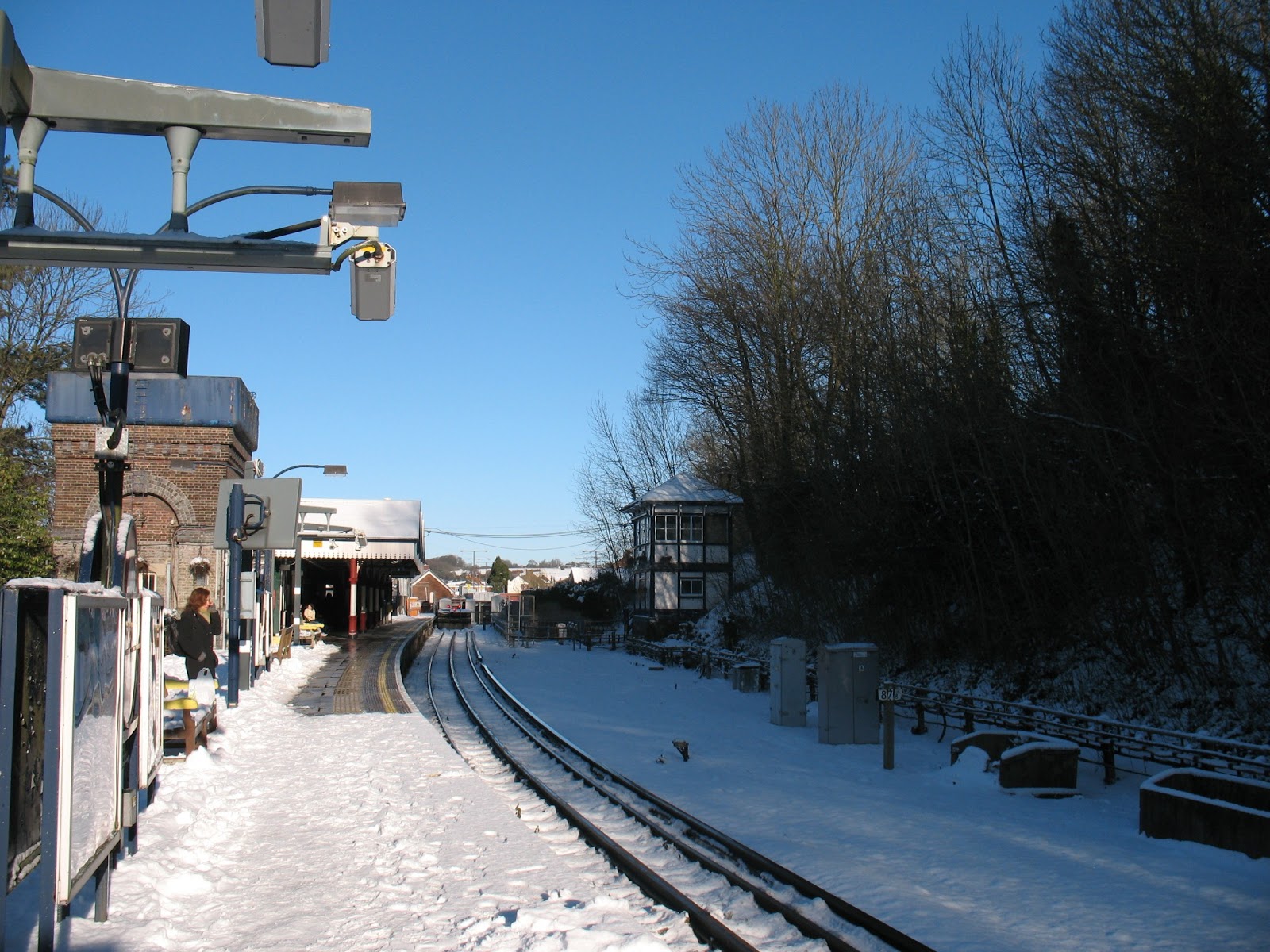
Chesham signal box
Chesham only needs one platform
Apart from the rolling stock, perhaps the most interesting contrast between then and now is that there were different classes of travel, as you can see from the sign 'Wait here for Third Class'. The passengers in the foreground look very much like this class of passenger to me. It's a reminder of the way that the coming of the London Underground and other railways transformed the lives of our ancestors. Cheap fares meant that people could now travel greater distances to work; it was the start of the age of the commuter. As the network of railways in and around London grew, so did the suburbs, whose attraction was that they combined the green and pleasant surroundings of the countryside with the convenience of the city. I'm sure that all of the thousands of London commuters who travel on the Underground every day appreciate these benefits (Note to self - 'Irony never works in print'). I used to be one of those commuters, my journey incorporating the historic Baker Street to Farringdon section. Chesham is at the very end of the Metropolitan line, so at least I always got a seat.

Chesham water tower
Although it is part of the London Underground network, Chesham is over 30 miles from central London and surrounded by open countryside. You have to walk uphill to get to our 'underground' station with its single platform, and the train doesn't actually go underground for about 25 miles. Although the trains are all electric now - we have some of the newest trains on the whole network now  - Chesham and some of the other stations on this stretch of the line still have many of the features of a bygone age. We have a signal box and a water tower, left over from the age of steam. You can tell that there is still water in the tower, because in the summer you can see the tops of the bulrushes that grow in it. If I had a better camera you'd be able to see the bulrushes properly. I did get a decent shot of the decorative cast iron pillars, though.

I can't finish a piece about the Underground without including a map. This one is from 1896, and shows both London Underground and a number of overground lines. If you are familiar with London you can have fun comparing it with today's network.


  Print

Wednesday, 2 January 2013

Ne'erday, a fine birthday for a Scotsman

Henry Collins 1905-1976
My grandfather, Henry Collins, was born 108 years ago today, on New Year's Day (Ne'erday) in Glasgow. He was the eldest of 9 children, and his parents got around to marrying two years later, shortly before the birth of his sister, Agnes. I remember him telling me that as child he spent a lot of time with his grandparents because there were so many younger children at home. I now know that at the time of the 1911 census they were all in the same household.

His grandfather, Thomas Cross, died at sea when Henry was 12 - I wrote about him in my most recent blog post for The National Archives, as part of the series 'My Tommy's War'.

The picture here is one of my favourites; I don't know exactly when it was taken, but I think it was around the time he married my grandmother, when he was only 18. They had eight children, two of whom died in childhood. My aunt Helen, known as Ella, was the eldest and the only girl, whose role was to help look after all her little brothers (who led her quite a dance!). Grandpa Henry was called up into the Royal Artillery in the Second World War, was captured and spent most of the war as a prisoner. He finally came home in 1946, and my youngest uncle, Charlie, was born in 1947, eight years after the previous child. Bearing in mind that Ella was 22 and still single at the time, I wonder how many people thought he was hers?

The Grandpa that I remember worked as a removal man, for Pickfords, and he did a lot of work at the US naval base at the Holy Loch on the Firth of Clyde. I have him to thank for my ability to pack really well; I don't know whether he taught my father, and I learnt in turn from him, or whether I have inherited some kind of 'packing gene'. Either way, it has proved very useful. Thanks, Grandpa.

I was the first of the Collins grandchildren, and for six years the only one, as a result of which I was completely spoiled by my grandparents, especially by him. Sadly, he died before my elder son, his first great-grandchild, was born. At his funeral his coffin was carried by his five sons and his son-in-law which was both  impressive and touching.

I always remember my Grandpa with great fondness, especially on his  birthday, when I always raise a glass to him as well as to the New Year. Slainthe Mhath.

  Print