Wednesday, 26 October 2011

What is your 'real' name'?

I'm always intrigued when people talk about a person's 'real' name, as though it is something fixed, like your eye colour or your fingerprints. But if you think about it, your name is just a label that is attached to you, usually at birth, by someone else. The name chosen for you is usually defined at least partly by convention, and partly the choice of the parents, but it's still a label. It is probably more accurate to call it your given name, and the convention in the English-speaking world is that you have a surname, which is your family name, and one or more first names. And that's pretty much it, at if you are male. If you are a female, you are generally expected to adopt your husband's surname when you marry, but you don't have to. The world in general is likely to assume that you have changed your name on marriage, but it's still up to you. Some American women adopt their husband's surname, and keep their maiden surname too, as in Hillary Rodham Clinton, but few British women do this. Among British women, Scottish women are much better than English ones at hanging on to their maiden names, in official records at least.

So far so good, but as genealogists often discover, many of our ancestors cannot be found because they are not listed under the name that we expect. Leaving aside mis-spellings and mis-transcriptions, there are many explanations for this, and it's important to realise that there was no reason for most name changes to be recorded officially until relatively recently. Even today, to the best of my knowledge, English common law is still perfectly happy with the notion of unofficial name-changing, provided it is not for any fraudulent purpose. In practice, however, your bank, the Passport Office, the Driving and Vehicle Licencing Authority and a host of other organizations take a different view, and insist on some documentary proof. But if you look back to the 19th century our ancestors would have encountered few situations where they needed to produce official documents, so the question of proving identity simply did not arise. If someone asked your name, they would, on the whole, accept whatever you told them without question. So the name on a person's marriage certificate can be different from the name on their birth certificate for all sorts of reasons; for example someone born before their parents married and  registered under their mother's surname would grow up using their father's surname. Similarly, someone brought up by a stepfather would be very likely to use his surname too. I have even come across some people in these situations who sometimes used one surname, and sometimes the other, for no particular reason.

Then there are people who make a deliberate choice to change their name, again, for a variety of reasons. Some people simply don't like the name their parents chose for them, and pick one that is more to their liking; others prefer their middle name to their first name and just swap the order. I have a friend who uses his middle name, and whose wife didn't like any of her three Christian names and was known to her friends by a different name altogether; when they got married some of the guests thought they had gone to the wrong church because they didn't recognize the 'correct' names on the order of service! Then there are people who have been adopted, and are given a completely new name. If you think about your own friends and family there are probably quite a few who don't use the name that is on their birth certificate, for all kinds of reasons. Now think about your ancestors: why would they be any different?

Changing your name officially by deed poll or by statutory declaration has become very popular in recent years, and there is an interesting feature about this on the BBC website That's going to be fun for the genealogists of the future! It won't be easy to trace through official records, either, because there is no central registration of legal changes of name in England and Wales. If you want to enroll your change of name with the Supreme Court, and thereby create a permanent official record, it costs extra, and most people decide not to bother. I sometimes have to deal with enquiries about changes of name in the course of my job, mainly from family historians, and it is sometimes difficult to persuade them that there may be no paper trail for them to follow. But just in case you are on the trail of one of the minority of name changes that is in the official records, there is a useful guide on The National Archives website.

 Print

Thursday, 6 October 2011

Doin' the archive two-step

The records we use in family history research were created for a number of reasons, none of which was the education and amusement of the 21st century genealogist. Some popular records have been name-indexed , but many have not. Where there is no nice modern index (ideally an online one linked to digitised images) then we just have to do some real research to find what we want.

Most of the records we hold at The National Archives were either created or collected by central government or the legal system, and at some point were actual working documents. This means that the people who used them had to have some means of finding what they needed, so they may have created their own indexes. Sometimes an index is part of the document itself, in a set of pages at the back of a book, and somtimes it is in a separate volume altogether. In this case the index will appear in the Catalogue as a separate document, and one index volume might also cover several record volumes. So that's why you often need to look at one document to identify the volume that contains the record you want in another, and to find the exact entry once you get there.

This can come as a shock to people who are venturing into archive research for the first time after using online indexes and digitised records. I'm sure that some of them think it's just an evil plot by archivists to confound the public. And while it is a bit of a nuisance, working your way through a system like this does have the advantage of helping you understand how the records were created.

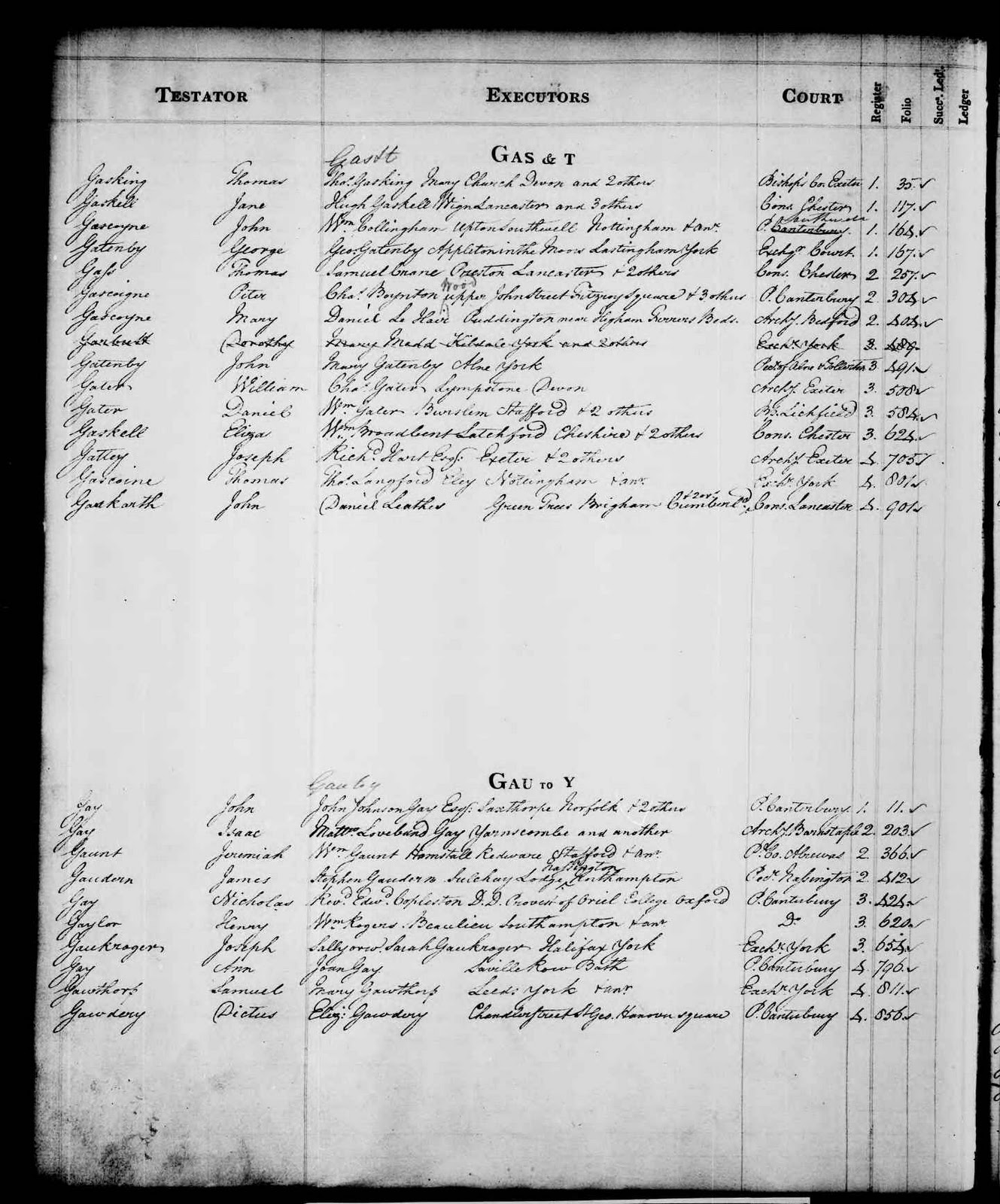
IR 27/153 (image from findmypast.co.uk)


One of my favourite record series that you have to search this way is Death Duty Registers. These are 19th century records (more or less - the actual time span is 1796-1903) that record the tax collected by the Inland Revenue on the estates of the deceased. They are well worth the extra effort required to access them, because they tell you something of what actually happened to a person's money, which might not be exactly as suggested by the will itself.  The records are in one record series (IR 26) and the indexes are in the following one (IR 27).

'Indexes' of this kind are not usually in strict alphabetical order, and when you think about it, that's not really surprising. They were created at the same time as the records, before computers, and the best way to understand them is to think of the way we used to keep paper address books. There is a page or section for each letter of the alphabet, and the entries are added as they occur. Death Duty Register indexes are annual, and the Inland Revenue, like some other departments, refined the system into 'cuts' as in the illustration, so that they didn't have to look through very long lists. Each entry then has a reference that will help locate the full entry in another book. There are fewer records of this kind than there used to be, because some records have been re-indexed from the original source, and sometimes digitised too, so you don't have to go the long way round any more. But there are still plenty left like this, so for the foreseeable future we still have to use the two-stage process of looking at a contemporary index first. 

If you really want to know more about Death Duty records there is a research guide on the subject.

Print

Sunday, 2 October 2011

Same BMD databases, different sites: Part One - England and Wales

There are many popular records that you can find on more than one genealogy site, and if you don't find what you want one one site, it's a good idea to try another one. There are two different reasons for this. Some records, like most British censuses, have been indexed independently by different service providers; in other cases exactly the same database appears on more than one site, but different search engines mean that one site may give better results than another. This is why it is sometimes worth using a commercial site to search indexes that are free elsewhere.


The Civil Registration birth, marriage and death indexes for England and Wales are available on a number of sites; none of them, sadly, provided by the General Register Office itself. The most widely used is FreeBMD an astonishing example of volunteer effort on a massive scale. As the name implies, it is free to use, and because it has only one function, searching the BMD indexes, it is expressly designed for that purpose, and it works extremely well.

Birth marriage and death indexes are also on Ancestry, Findmypast, TheGenealogist, BMDindexes and FamilyRelatives. BMDindexes is a standalone site which is also part of TheGenealogist, so the indexes are the same, but I can't comment beyond that because I am not a subscriber to either. Ancestry's indexes up to 1915 are the FreeBMD indexes, and are clearly listed as such, but for 1916 to 1983 they have their own indexes. Findmypast and FamilyRelatives have each done their own indexing, so for any period up to 1983 you have a choice of several independently compiled indexes. Indexes from 1984 to 2005 were 'born digital' and the databases used to be sold by the GRO to commercial companies. No indexes more recent than this are available online, with the exception of 2006 births and marriages which are on Findmypast only.

I may look at the relative merits of the various indexes some other time, but what I set out to discuss here was the reasons you might choose to one site rather than another for the same database. Specifically, why would you search for BMDs on Ancestry rather than FreeBMD? I have to admit that I nearly always use FreeBMD. The FreeBMD updates don't reach Ancestry straight away, although this is a minor issue, since most of the activity on FreeBMD these days is in the post-1915 period that they don't share with Ancestry. The question of coverage is still relevant, though, since even for the earlier years FreeBMD is not complete. The FreeBMD site itself has very informative coverage charts, which show you where the gaps are, but you won't find this information on Ancestry.

Another advantage of FreeBMD is that you can search just births, marriages or deaths, or across all three, and you can restrict your search to very specific time periods. This is possible on Ancestry, up to a point, but unless you want a single year or quarter, you can only select +/- 1, 2, 5, 10 or 20 years. You can also search just births, or marriages, or deaths, but not two or all three unless you want to search a lot of Ancestry's other databases at the same time.

After all this you might wonder why I would ever suggest searching these BMDs on Ancestry at all, since FreeBMD seems so much better. And since FreeBMD is free to use, and Ancestry is a commercial site, surely there is no contest? Well, actually there are several reasons for considering Ancestry. First of all, although it is a commercial site, some of its databases are free, including the FreeBMD ones, so cost is not an issue. Ancestry also has a number of features that can be useful for some searches.

When you search for a forename on Ancestry it will return all the results when that name appears in any part of the forename field, while FreeBMD only returns results where it is the first name, not one of the middle names (although FreeBMD will return middle name results if you put + in front of the forename). I have my own Ancestry search pages set to Old Search, with 'Exact matches only' as the default, but if you use New Search you can set a wider range of individual search options for each field. So a search for 'William' on Old Search will return William, William George, George William etc, and the default search option for the forename field on New Search will also return results like George W. There are other settings that you can experiment with, and the surname field offers both phonetic and Soundex options, which bring different results.

Another potentially useful feature of Ancestry is that surname search results will include those where it appears as the mother's maiden name in the birth indexes, although this only begins in the September quarter of 1911. If you are an Ancestry subscriber, results from FreeBMD indexes will be included in searches across multiple databases, which has the value of convenience.

So it's worth considering all the options, even if you are in the habit of using the same one all the time as a matter of habit. I certainly did when I was preparing the blog post. I shall probably use Ancestry a little more than previously, although FreeBMD will remain my first choice most of the time. But no matter which search option you choose, when it comes to ordering certificates make sure that you do this through the GRO's own Certificate Ordering service, or from the local register office, where it will cost £9.25. Anyone else who offers a certificate ordering service has to use the GRO service, so you might as well go direct and save yourself time and money.

Print

Monday, 19 September 2011

All 'conferenced' out

The Springfield Hilton prepares for the invasion
I'm writing this on a (very nice) train between Ottawa and Toronto, on a lovely sunny morning. I have been a bit of a blog-free zone lately, and it's nice to be back.

I was at the FGS conference in Springfield recently, where I gave three presentations, plus one at the pre-conference Librarians' Day. Then I was conveyed to Chicago, in chauffeur-driven splendour, courtesy of the magnificent Thomas McEntee. I managed to get myself sunburnt (ouch) when the weather was much hotter and sunnier than I'd been expecting. This is now fading and peeling, so I look a little less panda-like when I take off my sunglasses. Flaky and peeling isn't a great look, but it's better than red and glowing: for a while you could have used my nose to guide incoming aircraft.

After my R&R stop in Chicago, it was on to Ottawa for the BIFHSGO (British Isles Family History Society of Greater Ottawa) conference, held at Libraries and Archives Canada, where I gave another three presentations. Now I'm on my way to my final appearance, at the Toronto branch of the Ontario Genealogical Society tonight. I'm really looking forward to seeing Toronto again, after a gap of 25 years. Oddly enough, on my last visit I stayed in North York, where the society meets.

As if all this trains, planes and automobiles activity wasn't enough, I've also just finished co-writing a book, and the manuscript is finally with the publisher - for the last few weeks even my slacker conscience wouldn't let me write anything longer than a quick Facebook or Twitter post until it was all done, hence the lack of postings on the blog. As I said, it's nice to be back. I still have one conference to come, 'Celebrating the Census' day on 1 October,  part of the day job back at The National Archives.

I hope to write in more detail about the conferences, but for the moment I just want to say how much I enjoyed both the Springfield and Ottawa events. My US and Canadian hosts have been wonderful, and as always it was great to meet old friends, and make new ones. I'd like to thank the host societies for inviting to to speak, and the audiences for turning up to listen - and also for their many kind comments and positive feedback. In particular I'd like to thank David Rencher and my other friends at FamilySearch who arranged for me to use one of their projectors for my talks at Springfield, so I didn't have to bring one across the Atlantic with me, and then lug it around three other cities before going home. Guys, every time I get on or off a plane or a train I think of you with gratitude!

Print

Saturday, 6 August 2011

Follow Friday - The Dark Archivist


This is a bit of fun for Friday. The Dark Archivist is a cartoon super-hero, who hangs out at the Oxfordshire History Centre. This is the new name for the combined Oxfordshire Record Office, Oxfordshire Studies and Oxfordshire Health Archives. It is housed in St Luke's Church in Cowley, which was converted for use as the Record Office several years ago.

I once attended a fascinating talk and tour by the County Archivist, Carl Boardman, who told the story of how the redundant church premises were acquired to house the county archives. The church is a large one, but never had a large congregation to match. It was built by Lord Nuffield, founder of the Morris Motor Company and a great benefactor of Oxford and its university. He had the church built for the large number of new workers coming to Oxford to work in his factory, but didn't allow for the fact that they came from South Wales and most of them were nonconformists, and not members of the Church of England.

The conversion from church to record office was very nicely done, with the reading room in the former nave, and the archivist's office in the former organ loft. This gives the office a great view of the researchers below - any transgressors with pens of other forbidden items are swiftly detected. It's amazing how few people think of looking up.

The Dark Archivist was Carl Boardman's idea, and it went live in 2007. It's a different, and fun, way of looking at Oxford's history, even if you have no particular interest in the area. Although it is connected to the Oxfordshire History Centre site, it is not part of it, and the link isn't very prominent. So it's easier to find the standalone site. Have fun.

Print