Showing posts with label Archives. Show all posts

Saturday, 30 March 2013

Shopping Saturday - Marks in Time


Marks and Spencer is close to the heart of many a Brit, or at least close to their skin - or in their underwear drawer.  Marks in Time is the website of the M&S company Archives, and it recently celebrated its first anniversary. The archive itself is housed in the University of Leeds, and the website is well worth a visit, whether you are a serious student of retail history or you just like looking at old pictures. The site makes very good use of the company's extensive collection of images - photographs of buildings and people, and packaging and merchandise. For the Baby Boomer generation, that iconic 1970's fashion statement platform shoes will take you right back! You can do simple or advanced searches of the catalogue, with an option to select only items with images, and you can choose from a drop-down menu of subjects such as 'wartime', 'food and home', 'children' and so on. When I searched for all items with images in the category 'women', I found, as expected, lots of clothing items, but also wine labels and bars of chocolate. Makes sense, I suppose.

As well as the archive catalogue, there is a history of the company since its famous start as a Penny Bazaar in Leeds Market, complete with a timeline, biographies and memories. There is also a fine collection of resources for schools, including a game where you match the fashion to the decade. I have already spent more time than I intended to exploring - well, it's cold outside! Feel free to do the same.

Print

Friday, 23 March 2012

Those Places Thursday - Chesham 'Boots, brushes and baptists'

Ornamental pillars at
Chesham station
Chesham is a market town in Buckinghamshire, and it has been my home since 2002. It's a nice place to live, surrounded by the open countryside of the Chiltern hills, but with a fast train service to London. In fact, the station is art of the London Underground, despite the fact that you have to walk up quite a steep hill to get to the station, and travel about 20 miles before the train actually goes under the ground. There is still a water-tower, a reminder of the days of steam trains, and there must still be water in it, because in the summer you can see bullrushes growing there.

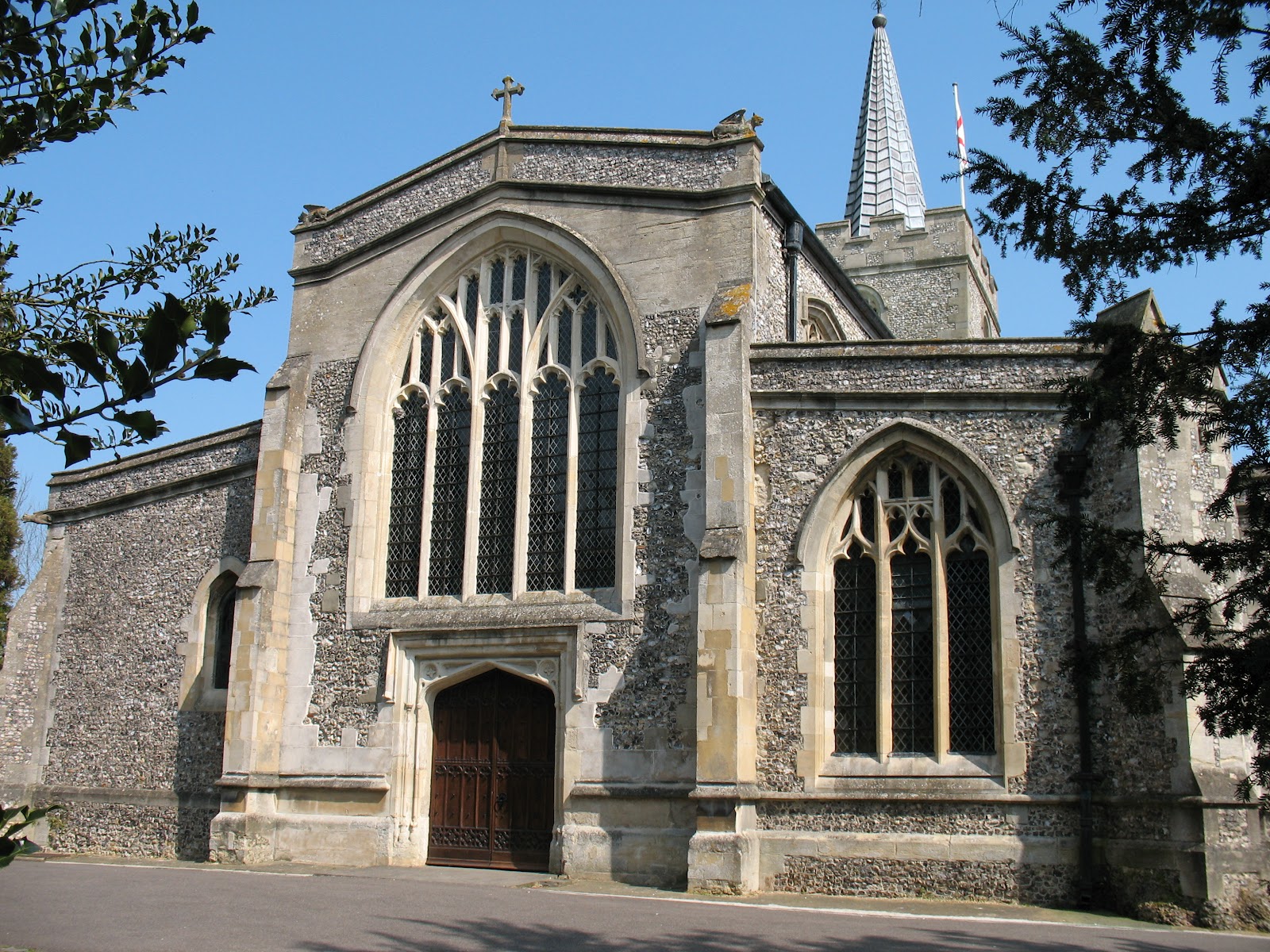
It is a pretty little town, with a proper high street that still has independent shops, and a market twice a week. There used to be a market hall, too, but only the clock tower remains, as the main building was demolished a number of years ago. There is a medieval parish church, and wide range of other places of worship; Methodist, Roman Catholic, United Reformed, Salvation Army, Spiritualist and two Baptist churches (there used to be three) as well as a mosque. The local branch library is not very big, but it has a good family history and local history section. But the best place to start if you want to know about the town's history is Chesham Museum. Their site has a great collection of photographs and links to lots of other useful resources. One of the most interesting is the Roll of Honour listing the names of Chesham men who fell in the two world wars, with biographical details for most of them.

Chesham War Memorial - Remembrance Day parade 2010
Chesham was in the registration district of Amersham, from 1837 until 1974, since when it has been part of the Buckinghamshire district. Registration districts were based on Poor Law Unions, formed in 1834 by amalgamating groups of parishes. The Union Workhouse and the administration of the Union were usually based in the largest parish in the Union. In 1834 Chesham was much the largest of the parishes concerned, but the Poor Law Commissioners judged that the parish workhouse in Chesham was badly run, so the new Union was based on Amersham instead. When the paupers in the old parish workhouse were moved to Amersham in 1835, there was riot in the streets of Chesham. There is an account of this and more about the history of Amersham Union on Peter Higginbottom's wonderful The Workhouse site.

Parish church of St Mary, Chesham
Most of the records for Chesham are held at the Centre for Buckinghamshire Studies in Aylesbury, but those for the various nonconformist churches and chapels are at The National Archives in record series RG4 and RG 6. They can be searched and downloaded from the BMDregisters site. Another good way of finding out about Chesham, its records, and where they are held is by entering it as a search term on England Jurisdictions 1851 which is part of FamilySearch. 


The George and Dragon
For general information, maps and population statistics there is A Vision of Britain Through Time and you will find pictures of listed buildings on the Images of England site. This last works better if you register (free of charge) to use the advanced search facility. 

The listed buildings include the George and Dragon (left) in the High Street. Quite a number of pubs all over the country have closed in recent years, including this one, but fortunately it has recently re-opened under new management; it's much too attractive to be empty and unused.

Finally, I haven't forgotten about the 'Boots, brushes and Baptists' part of the title, above. This is something I was told by the estate agent when I was looking at houses here, and it reflects some of the main features of the town's history. I've already explained the 'Baptists' part, and two of the main local industries were the manufacture of small wood items, especially brushes, and boot making. You can see this for yourself by browsing the census for Chesham, where you will see that much of the population was engaged in one of these occupations. You might also notice that many of the women worked in lace-making or straw-plaiting, but neither of these starts with B so it wouldn't be such a snappy title if they were included.


 Print

Saturday, 3 December 2011

Cause papers 1300-1858: disputes in the north of England

Cause papers in the diocesan courts in the Archbishopric of York, 1300-1858 is a searchable catalogue of more than five centuries' worth of papers relating to cases in the church courts. The Advanced Search allows you to search by name, place, type of case, occupation and more. The cases dealt with in the church courts included matrimonial and testamentary disputes, defamation and matters of moral conduct. They also heard cases regarding church affairs such as tithes, church rights and benefices.

York Minster
The database includes the names of everyone involved in each case, witnesses, proctors (ecclesiastical lawyers) as well as the parties in dispute, and even the names of the testators in disputed will cases. Occupation or status is also given, and in the case of witnesses, their ages too. Sometimes there is a brief abstract of the case, or, even better, you can view and download scanned images of the papers themselves. If there are no images to download, you can order copies from the Borthwick Institute, where the records are held. you are also encouraged to contribute to this ongoing project by adding abstracts of the cases or by editing existing ones.

These records are a terrific source for family and local historians. not only are they full of names, they also give a glimpse into the daily lives of people who may be otherwise unrecorded beyond their baptisms, marriages and burials. Some of the cases involve large numbers of people, such as the 1753 case involving brawling in church at Newark on Trent, Nottinghamshire; Edward Grave, the churchwarden, brought the case against John Atkinson, a fellmonger, and no less than 17 witnesses were called. There are 43 pages of proceedings to download and read, which are fortunately very legible - some of the earlier ones present more of a challenge, but there is plenty of help to be had, such as The National Archives resources for Reading old documents.

All the places referred to in the cases are indexed, and they extend well beyond area over which the diocesan courts of the Archbishopric of York had jurisdiction. For example, the case of Edward Bailey, colonel in the West Middlesex Militia in 1812, includes many references to addresses in London. All places referred to in the cases are indexed, and they can be very detailed indeed, right down to street addresses in towns and field names in the countryside.

This is a site that is well worth exploring, especially if your ancestral interests lie in England's northern counties. Even if there are no cases of specific interest, it gives you an indication of just how detailed and interesting court records can be. They are largely unexplored because there are not many name indexes, without which you would have no inkling that an ancestor was ever involved in a court case.

 Print

Saturday, 6 August 2011

Follow Friday - The Dark Archivist


This is a bit of fun for Friday. The Dark Archivist is a cartoon super-hero, who hangs out at the Oxfordshire History Centre. This is the new name for the combined Oxfordshire Record Office, Oxfordshire Studies and Oxfordshire Health Archives. It is housed in St Luke's Church in Cowley, which was converted for use as the Record Office several years ago.

I once attended a fascinating talk and tour by the County Archivist, Carl Boardman, who told the story of how the redundant church premises were acquired to house the county archives. The church is a large one, but never had a large congregation to match. It was built by Lord Nuffield, founder of the Morris Motor Company and a great benefactor of Oxford and its university. He had the church built for the large number of new workers coming to Oxford to work in his factory, but didn't allow for the fact that they came from South Wales and most of them were nonconformists, and not members of the Church of England.

The conversion from church to record office was very nicely done, with the reading room in the former nave, and the archivist's office in the former organ loft. This gives the office a great view of the researchers below - any transgressors with pens of other forbidden items are swiftly detected. It's amazing how few people think of looking up.

The Dark Archivist was Carl Boardman's idea, and it went live in 2007. It's a different, and fun, way of looking at Oxford's history, even if you have no particular interest in the area. Although it is connected to the Oxfordshire History Centre site, it is not part of it, and the link isn't very prominent. So it's easier to find the standalone site. Have fun.

Print